
'Modi should not feel shy of proclaiming as the meaning of secularism regard for all religions in proportion to their numbers in tune with the spirit of democracy and adopting it as State policy,' says B S Raghavan.
The Hindu right-wing body in its mouthpiece taunts "liberals" protesting the Dadri lynching incident, asking what exactly is their idea of India.

All those peaceniks and bleeding-heart liberals spewing nonsense about 'uninterrupted and uninterruptible' dialogue with Pakistan should pause to ponder the futility of talking to someone who is unwilling and unready to resile an inch from its unacceptable and unreasonable stand, says Virendra Kapoor.
For both India and China, the most likely option -- and the most challenging -- appears to be a freezing of the status quo.
While the BPF and the UPPL are considered rivals in the Bodo-dominated areas, there was no pre-poll alliance among other parties as well.
A group of 10 JNU teachers has released a 400-page document prepared last year detailing past controversial events on the campus.
A realistic assessment will tell us that not much has changed between India and Pakistan; the relationship remains as fraught as before with little prospect of reconciliation, notes Ajai Shukla.

The government must figure out what the Chinese game plan is and thwart the endgame before it is upon us, possibly in early winter, advises David Devadas.

'The credit for managing Trump should go to Modi.' 'Biden is a predictable and rational person with plenty of administrative experience,' notes Ambassador T P Sreenivasan.
'A great General who had become a legend in his lifetime.' 'India will not see the likes of Sagat Singh again.'
'Like General Patton, possibly the greatest exponent of the art of war, Vajpayee had the ability to be always on the offensive,' assesses Colonel Anil A Athale (retd).

Mohammad Rafiq Shah was president of the J&K Peoples Liberation League.

'Local support is very important, without it the terror attack couldn't have taken place.' 'Explosives were secured, the IED was manufactured, the boy was brainwashed and converted into a suicide bomber... it takes a lot of planning and hard work.'

The statement came a day after Indian Army launched "punitive fire assaults" on Pakistani positions across LoC.
'The Pakistani military has encouraged and supported terrorist organisations, especially in Kashmir, as a means of waging proxy war against the Indian military and the country's superior economic resources.' 'The evidence is irrefutable with the recent killing of 46 paramilitary troops being just the latest example.'
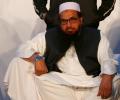
The perpetrators of the 2008 Mumbai attack, who shot dead 166 people, had confessed to details that should have been enough to hang him, but Pakistan enjoyed his anti-India rhetoric and let him spread his tentacles. A revealing excerpt from Khaled Ahmed's Pakistan's Terror Conundrum.

The statehood issue and implementation of the sixth schedule of the Constitution have been the major demands in the hills since the beginning of the protracted Gorkhaland movement in 1986.

The sources also said another round of military talks between the two sides on Wednesday to defuse tensions in the area remained inconclusive. The talks lasted nearly seven hours.

What the Indian economy looks like next January will influence her view on India, not her genetics, notes Shekhar Gupta.
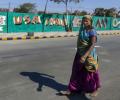
'The best thing that Modi can hope for in this visit is that he is able to mobilise Indians in America to vote Republican and try and help Trump return to power,' argues Aakar Patel.
'The general perspective -- certainly on Capitol Hill and Congress -- the love for India, the positive feeling for India still focuses on India as a democracy.' 'The more that Indian democracy and its pluralistic features is called into question by Indians, the more that same debate will replay back here.'

Events in America have strengthened the hand of those leaders there who wish India well, but think of India as being a collection of Indians.
If Indians are mistreated, they will object, asserts Aakar Patel.

'Having dealt with security and insurgency for 15 years, I am fully convinced that the steps taken by the government in regard to J&K and the measures in force there are essential,' says B S Raghavan, the distinguished civil servant.
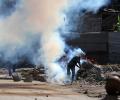
For a Valley on the boil, there is ample proof that New Delhi simply does not care.

Prime Minister Narendra Modi raised the issue of Chinese incursions with the visiting Chinese President Xi Jinping during their meeting on Wednesday night.
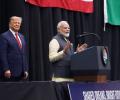
'Howdy Modi is an unforgettable celebration of the crowning of Modi as a world statesman,' says B S Raghavan, the distinguished civil servant.

'All the government needs to do is to identify clear political and strategic objectives and to give the military planners a free hand,' asserts Ajai Shukla.
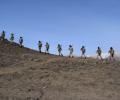
India brought in more troops after the destruction of two of its bunkers and "aggressive tactics" adopted by the Chinese People's Liberation Army
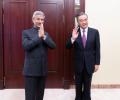
'It is advisable for Indian interlocutors to follow the Chinese tactic of repeating the Indian position, both for the record and to test the Chinese negotiator's resolve and intentions.' A riveting excerpt from former foreign secretary Vijay Gokhale's The Long Game: How the Chinese Negotiate With India.

President Ram Nath Kovind addressed the nation on the eve of India's 75th Independence Day. Here's the text of what he said:

'One must remember that a dragon has a forked tongue,' warns Vivek Gumaste.

Prime Minister Modi made a strategic blunder of Nehruvian proportions -- presuming no war can happen now, and the Chinese won't be a military threat and risk their economic interests, observes Shekhar Gupta.
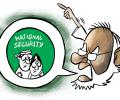
Modi-Shah BJP has resurrected dangers and the enemy from the past and built a scary jingoism. It's a great diversionary tactic but history shows it never ends well, points out Shekhar Gupta.
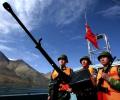
The Chinese side has particularly bolstered its presence in the Galwan Valley, erecting around 100 tents in the last two weeks and bringing in heavy equipment for construction of bunkers, notwithstanding the stiff protest by Indian troops. There have been reports of multiple incidents of transgressions by Chinese troops in several areas in Eastern Ladakh.
The report said the outfit might have linkages with other ethnic insurgent groups active in neighbouring states, and receives aid from "unknown external sources".
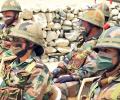
On the shopping list: Light tanks, anti-tank guided missiles, UAVs, assault rifles, fighter aircraft.
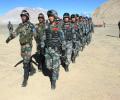
'They have done in Eastern Ladakh what we did in Dokalam in 2017.'

'I don't see how any Indian government or any Indian military leadership can now ask the soldiers to patrol without weapons.'
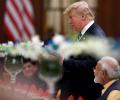
Modi may take satisfaction from his display of considerable political skill in managing a mercurial, temperamental and unpredictable US president and nudging him into uncharacteristic restraint and even carefully orchestrated remarks. This personal chemistry will come in handy if Trump returns as president in the November elections, says former foreign secretary Shyam Saran.
Jammu and Kashmir will receive 'liberal financial support' for modernisation projects from the Asian Development Bank, the government said on Thursday.
